So who is this weirdo?

Hi! My name is Liam and I am a beginner birder living in Glen Massey. I first became interested in birds after a 6-month missions trip to Papua New Guinea in 2016, and my interest grew from there! I am now a member of the Ornithological Society of New Zealand and Young Birders New Zealand (OSNZ and YBNZ respectively ). So now, I'm starting this blog so I can share my birding adventures with anyone who will listen ☺.
Showing posts with label Miranda. Show all posts

Thursday, 26 December 2019

Dipping in the Firth of Thames

My alarm woke me at the hideous hour of 4am, a time when sensible birds and people are in bed. The moreporks kept me company while I loaded my scope, camera, binoculars into the boot of my car and set off by 4:30. Picking up my birding companion and best friend Shoshanah on the way, we headed north towards Whangamarino wetland for our first stop. We got out at Falls Road, but rather than hearing the crakes, bitterns and fernbirds that we were expecting, we heard nothing but the whine of mosquitoes and a single morepork that was staying up late. Our attempts at silence were punctuated by our attempts to end the insects that were causing us so much grief, to no avail. No time to waste, as the sun was beginning to rise.

Miranda was our next stop, and we were awestruck by the thousands of birds wheeling around our heads as the sky begun to lighten. Pied Stilts, Bar-tailed Godwits and Red Knot were all abundant and vocal, while around thirty Pacific Golden-Plovers were roosting beside the carpark. Not content with these beautiful migrants, we resolved to chase down the Broad-billed Sandpiper that had been making an appearance over the past few weeks. After sifting through masses of birds next to the Stilt Hide, we had seen Wrybill, Turnstone and New Zealand Dotterel, but nothing smaller or broad-billier. Walking further down the track, we were in luck - a Pectoral and a Sharp-tailed Sandpiper were both feeding alongside Banded Dotterels, and we strained our eyes for the Red-necked Stint group that the broadie had been hanging out with.

Another hour of searching, and no luck. We trudged back to the Godwit hide and were astounded by the closeness of the birds now that the tide had receded - Shoshanah managed to pick out the three Far Eastern Curlew that had been overwintering, a nice consolation prize. No more time to waste, so we drove to the East Piako flood plains to search the flooded stopbank for a Hudsonian Godwit. Out of luck again - we scrutinised each and every godwit and found only Bar-tailed. Another dip.

Undeterred, Thames Bird Hide was our next stop - a crummy, graffitied hut only 300 metres or so from the town centre - surely the least likely spot for good birds. Nevertheless, there were two Brown Teal right outside - pretty good birds! Bracing ourselves for heavy traffic, we were pleasantly surprised to find empty roads up the west coast of the Coromandel peninsula, meaning that we could nab Spotted Shags only a few metres away! Seawatching was fruitless, however, and we had only Australasian Gannets for company - no skua or shearwaters that we expected. All in all we had racked up a spectacular 'dip list' - Curlew Sandpiper, Hudsonian Godwit, Broad-billed Sandpiper, Fluttering Shearwater, Arctic Skua... the list goes on! Regardless, we had a superb morning out and it was a great start to Christmas.

A cute immature White-faced Heron

Ruddy Turnstones amidst Wrybill

A distant but distinctive Far-Eastern Curlew

A pair of Brown Teal

Monday, 16 July 2018

Second time lucky!

On the 19th of May this year, a single drake Northern Shoveler was spotted on the Stilt Pools at Miranda. This bird was the precursor to a whole spate of sightings, all drakes, from anywhere from Christchurch to Nelson, to Hawkes Bay. In total, at its peak, the Northern Shoveler incursion had peaked at six birds. Incredibly, this was almost half of the total number of accepted sightings ever!

The day after the Miranda bird was spotted, I managed to score a lift from my girlfriend's parents to go and try to see the bird. Despite my fast response, all I got were comments of "You should have been there this morning", and the prestigious title of Bird of the Trip had to go to the Kotuku (White Heron) in the mangroves. No shoveler for me.

The sightings continued to roll in, and it seemed that every birder I knew had seen that bird. My inbox filled up with rare bird alerts, all pertaining to the multitude of shovelers. A few weeks and I was convinced that I was being taunted by this bird. With typical bad timing, my mid-year examinations started straight after I dipped, cutting my days down to school, study and sleep. With slothlike sluggishness, that horrendous time passed, and so I again turned my thoughts to that miscreant bird. Every day could be its last in the country. But miraculously, instead of flying over the horizon, another shoveler turned up! My hopes soared, and I fought for a chance to twitch once more. Of course, my parents were baffled, as to them a duck is a duck. But I must have done something right, and so one Sunday morning, on the first of July, my wonderful mother let me drive us up to the stilt pools once more. After some pretty non-committal comments from Keith Woodley, I ventured out with a scope on my shoulder. No stone was left unturned, no Australian Shoveler unchecked. At ten I hunkered down in the hide, straining my eyes and holding my breath as I surveyed the far-off ducks on the shellbank. This was the spot that had been the most reliable in the past six weeks, and as you can imagine I was almost shaking. While the Royal Spoonbills were nice enough, the duck remained elusive as others came and went. It had been sighted only two days prior, and so it seemed to be just my luck that this was a seemingly invisible bird.

The heat haze shimmered in front of two shovelers, one obscuring the other, as I tracked them at 60x magnification. The front bird was an Australian Shoveler, the back bird... I would find out in the next few seconds. As one slowly overtook the other, I began to see the all green head and white body of a Northern Shoveler! At first, I had to blink a few times to confirm that it wasn't a hallucination conjured up by my racing mind. After pinching myself, it was still there in all its glory! Tick! I had a good look for about half a minute, then took my eye away from the scope to record the bird. When I searched for the bird again, it was gone. Ephemeral, almost dreamlike, a needle in a stack of haystacks. Mine was the second-to-last sighting, and the bird has not been seen since. No photos for me, no field sketches. Just a mark in a book and a second-rate blog post. Birding in its arguably purest form. As I wandered back to the Shorebird Centre, the Kotuku put its head up from its position amongst the mangroves and watched me go.

Saturday, 23 December 2017

2017 Birdathon!


3am came in the form of Joe stomping into the lounge and turning the lights on, while the more sane neighbours slept on. Not us though, and I rolled off the couch and coaxed my body into reluctant action. I had a quick breakfast of cheese and crackers, (the breakfast of champions) washed down with an oddly warm Up & Go, and grabbed my gear. I crammed my supplies into “Georgie” - Donald's wonderful vehicle - and we hit the road.

So why were we getting up at such an obscene hour? For the 2017 Birdathon of course! Our team - the Crakeless Spotters - consisted of Michael Burton-Smith, Joe Dillon, Oscar Thomas, myself, and driver Donald Snook, were setting out to break the Waikato record of 73 species seen in 24 hours. Much like camel polo or cardboard tube fighting, this was a hotly contested competition with a promise of eternal fame and glory, so we were taking it very seriously.

We headed south from Donald's house in Whangaparoa, and as soon as we crossed the Auckland-Waikato border, our count began, at bang-on 5:00am. It was unsurprisingly dark, and unpredictability foggy so we would need to be uber-focused. A certain team member, however, didn't see it that way and fell asleep. Lightweight.

Our first stop was Whangamarino Wetland, where as we rolled along the road a small flock of Spur-winged Plovers became Bird Number One on the trip list, at 5:09. As we continued along the road less travelled, we saw a Pukeko and a few Black Swans, bringing the total up to a whopping 3 birds! 70 to go. We stopped at Coal Bucket Marsh, where the birds began to flow in. While we couldn't actually see anything due to the thick fog, we heard some of the common passerines and more notably a Fernbird, the only one for the trip. We sped on to Falls Road, where a Sacred Kingfisher and a pair of Eastern Rosellas were spied. We pulled into one of the many pond tracks and followed a beaten-down trail into the wetland. As we approached one of the maimais a Dunnock began singing - number 19. Australian Shoveler and Grey Teal were both present, along with a few Mallards and confusingly mucky hybrids. Two Feral Pigeons were present in one of the maimais, and a New Zealand Dabchick flew into view (the first time I have seen one in flight). On our way out we heard a Spotless Crake bubbling away, followed by its characteristic prrrrrr. We heard an Indian Peafowl or two, then moved on to the Falls Road Lookout, where we added Black Shag, White-faced Heron and confirmed Pied Stilt, along with a few more common passerines and a Shining Cuckoo to pad our total out to a nice 37 species, and we were well on schedule.

Next stop was Miranda Shorebird Centre, where we arrived at around 7:30 to catch the falling tide. On our way to the Centre, we made good use of Georgie’s sunroof, and Michael spotted distant Greylag Geese in the southern paddocks. Keith Woodley generously let us hire some decent scopes, and almost immediately we added Bar-tailed Godwit, Red Knot, and South Island Pied Oystercatcher. After a little more searching, we spotted Wrybill, New Zealand Dotterel, LOTS of Pacific Golden-Plovers (almost a hundred if I remember correctly) and Ruddy Turnstone. After scanning the distant shellbanks White-fronted and Caspian Terns became birds 51 and 52, respectively. Black-backed and Black-billed Gulls made an appearance, although to my surprise no Red-billed Gulls. At the Stilt Hide, we managed to pick out five Banded Dotterel, one in beautiful breeding plumage. This was a relief to me, as last month I unwittingly sent two Texan birders on a wild goose chase (hehe) up the coast after Bandies, only to find out they were all in Aussie! 5 Sharp-tailed Sandpipers were probing the mud on the other side of the Stilt Pools, and soon after we made our escape. Somehow we missed Banded Rail in the mangroves, but we had no choice but to suck it up and press on.

The early morning Bar-tailed Godwits
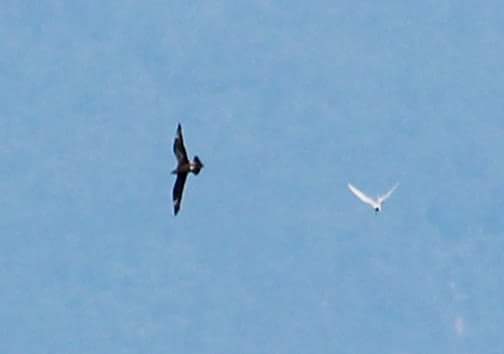
We powered up to Te Puru on the Coromandel Peninsula, ticking Red-billed Gulls (finally!) on the way. A huge colony of Spotted Shags followed, probably more than a hundred birds. We pulled over and hunkered down for a seawatch, and pretty soon I spotted a dark gull-like bird chasing a tern. “SKUA!” I called out and watched in awe as it performed some superb aerial acrobatics. The others got onto the bird soon after and it was decided that this bird was an Arctic Skua (Parasitic Jaeger). This led to a small crisis when a certain team member accidentally recorded it as an Arctic Tern and unwittingly triggered rare bird reports around the nation, but Joe shall remain nameless. Anyway, I realised that we had seriously missed an easy species - Gannet! So we strained our eyes for the glimpse of one, and finally, one was spotted far off on the horizon, diving into the sea. Australasian Gannet was number 59. On our way down, Oscar suggested that we should have another try for Banded Rail, so we headed to the Karaka Bird Hide in Thames. No rails except those of the model train, however, so we tried to transform one of the numerous White-faced Herons into Reef Herons, to no avail. We were about to leave when I suggested that perhaps this would be a good spot for Brown Teal, so we checked the Mallard flock that was almost at our feet… and lo and behold! A single Brown Teal, right in front of us! Bird number 60! We continued our long southbound journey, and on the way finished off our shag set with a Little Black Shag.


Arctic Skua on left, White-fronted Tern on right. Photo courtesy of Donald Snook.
White-fronted Terns and Spotted Shags
View from the Karaka Bird Hide (Thames). Can you spot the Brown Teal?
We wound up crossing Lake Karapiro, where I again utilised the fantastic sunroof and we spotted New Zealand Scaup on our way to the southern end of Maungatautari. When we arrived at the maunga a pair of California Quail ran along the path while a New Zealand Pigeon swooped from one of the huge rimu trees. As we went deeper into the native bush North Island Robins and Tomtits called as a Kaka screamed overhead. A small flock of Whiteheads buzzed near us, and we began to climb the 16m viewing tower. A Bellbird called, as did Saddleback and Stitchbirds. A New Zealand Falcon zoomed over the canopy, screaming before stooping at unimaginable speeds towards some hapless animal. Number 72, and we were now 2 birds away from claiming the Waikato record! We walked up the Rimu track in search of the elusive Kokako and noisy Yellow-crowned Parakeet, but found neither, and left Maungatautari at about 4:00, heading north again to Cambridge.
We realised that Canada Goose was still missing from our list, and eyes were peeled as we again crossed Karapiro, until finally, Michael spotted a small flock bobbing on the lake. High fives all around, as we were now on the threshold of glory. We arrived at Lake Te Ko Utu with high expectations, and claimed Eurasian Coot as number 74! We made it, despite dipping on so many species (Wild Turkey, Banded Rail, Lesser Redpoll). We all grabbed pizza in Cambridge and drove up to Maungakawa to eat it, where we were promised Redpoll. It seems, however, that we had been duped. No Redpoll here. We soldiered on, to the North End of Maungatautari where once the sun went down we ticked Morepork, our last bird of the day - number 75. We searched for kiwi but no luck, we would have to be content with 75. It was a nice round number anyway.

We got out of Maungatautari at 10, and I finally got to bed at 11:30, buzzing from the thrill of being champions of the Waikato (the V helped too!). Credit must go to Donald Snook, our fantastic driver, and to Georgie, his fantastic van. And of course, to the idiosyncratic and ineffable Michael, who planned the entire trip.

Biggest dips were a few of the Arctic waders, Fluttering Shearwater, Lesser Redpoll, Banded Rail, Australasian Bittern, Royal Spoonbill and… Wild Turkey! We couldn’t believe we missed that one. Next time eh?

Tuesday, 28 November 2017

Holidays!

My last exam was finally over on Thursday 23rd, and I was well and truly on holiday! By Friday afternoon, I was packing my bag with binoculars, scope and field guide. My parents drove three of us young birders up to Miranda Shorebird Centre, pausing at Whangamarino Wetland on the way just to check for bittern. No luck, but we were undeterred. After some 'shortcuts' from Dad, we arrived at the Centre, where we were greeted by a friendly Keith and shown our dorms.

Now, I have just written a really long 3-part post on Miranda from about this time last month, so I won't repeat everything. This is just the highlights... I also must admit these are not my photos - I wish! They were taken by the other two YB's - Adi and Joe.

Saturday morning we walked up to the shellbanks and stilt pools, where we got to try out the new hides (Stilt and Wrybill hides). Along with the common ducks etc we saw a few New Zealand Dotterel, a single Banded Dotterel (our only one for the trip) and a Sharp-tailed Sandpiper. Now, Keith had promised us free accomodation if we found a new bird for New Zealand, so we desperately tried to turn some of the dotterels into Kentish Plovers and some of the godwits into Marbled Godwits, but to no avail. At the main (Godwit) hide, we saw a beautiful juvenile 'Sharpie', and a Curlew Sandpiper along with the innumerable Bar-tailed Godwits and Red Knot. White-fronted Tern were common along with Black-billed Gulls. What can only be described as 'oodles' of Pacific Golden-Plovers were also present, the most I had ever seen at one time. Of course, we learnt that if only we had been a little earlier we would have seen a Cattle Egret in beautiful breeding plumage - that would have been a new bird for my NZ list...

White-faced Heron with an eel


One of the upsides of birding in New Zealand is the sheer number of pelagic or ocean-going birds. However that one came back to bite us when Joe spotted a dark seabird sitting on the ocean in the distance. I opened my guide, only to find that the bird could be any of the following:

  • Grey-faced Petrel
  • Black Petrel
  • Flesh-footed Shearwater
  • Wedge-tailed Shearwater
  • Sooty Shearwater
  • Short-tailed Shearwater
That is New Zealand for you! With no chance of ID'ing it, we kept watching the distant ocean until Joe (again!) saw two Skua harrying some unfortunate terns, which with the help of some other birders we identified as Arctic Skua (or Parasitic Jaegar). Number 112 on my year list!

I had the awesome privilege of being able to show some Texan birders some of our extra-special birds such as NZ Dotterels and Wrybill, and it struck me as odd how we had such different reasons for coming. We were both birding, but Martin was on the lookout for Wrybill - a common bird here - and here I was getting excited about the solitary Curlew Sandpiper we had! When they described their common shorebirds in Texas, they more or less named some of the rarest waders in NZ, none of which I had seen. Anyway, they gave us a lift back to the Centre, where we parted ways - they only had a day and a half in NZ!

Me in front and Joe behind - counting Pacific Golden-Plovers

One of the PGP's in question


In the afternoon, we walked up to Kaiaua where we saw.... lots of White-fronted Terns. We were hoping for the ironically named 'Common Tern' or 'Arctic Tern', but no luck. We had fish and chips and headed back.

White-fronted Terns

A greedy juvenile Black-backed Gull

Variable Oystercatcher and NZ Dotterel


The next morning we got to the hides earlier to catch the Cattle Egret, but it again eluded us. The only bird of note that I haven't mentioned earlier was a Brown Teal off on the shellbank. Our time here was over, and the holidays had started out with a hiss and a roar.

Welcome Swallow by the hide

Monday, 13 November 2017

Miranda Banding Camp! - Day 3

My dreams were rudely interrupted by another 5am start, followed by a mad dash to the first vehicle. As I was still almost entirely asleep, this was a race I lost, but eventually I was able to clamber into a car and we drove to the Miranda Orchard once again. Mist nets were up again, and banding started pretty soon after I arrived. Once again, I was struck by the realisation that New Zealand's avifauna must be almost entirely composed of Silvereyes, as somehow these were the only birds I got to band. Luck of the draw I suppose, but it was a bitter pill to watch others band Sacred Kingfishers, Goldfinches, House Sparrows, Blackbirds, Thrushes, a Fantail and a Starling. Regardless, it was a fantastic morning for everyone, and we banded a total of 48 birds that day. I had the privilege of extracting a Fantail from the net, which was simply amazing. Excluding the tail, these are NZ's smallest birds, and to me this bird felt impossibly light and fragile. Again, all birds were extracted without a problem, and we celebrated another great banding session with another amazing lunch.

After lunch, we were given the option of more banding, or birding. As Michael assured me he knew a great spot for terns, I went with the birding option, and George, Michael and I headed to Ray's Rest with the incredible Paul, all the while dreaming of rare birds. Michael got doubly excited when he realised it was low tide, which "is the best time for terns". Like a fool, I believed him.

We saw a total of 3 terns, all Caspian Terns. This was after a 4km walk in the sun, and the price we paid for this infinitesimal victory was 'birder's burn' on our necks due to our ubiquitous binocular straps. Cheers Michael. We then walked on to the main hide, where we saw many more terns, although sadly only Caspian and White-Fronted Terns. No Arctics, Commons or Antarctics for us. We birded around the stilt ponds for a few hours, again seeing the Curlew Sandpiper, Marsh Sandpiper, Sharp-Tailed Sandpiper and Brown Teal among the more common birds. Despite earlier disappointment, this was a great time for birding, and we eventually returned to the Shorebird Centre exhausted, as the others regaled us with tales of banding success that afternoon...

After dinner was when the real excitement began. As the sun set, we strung mist nets over the fetid, stinking Stilt Pools, in preparation for Godwits, Knot and Pied Stilts. Adrian, the 'boss bander' of the weekend, staked out with a thermal imaging scope (so jealous 😀 ) while the procedure was explained to us. One or two lucky individuals would be selected to go with Adrian to retrieve the birds, and take them to the banding station we had set up between the two big vehicles. Then another person would have the honour of banding, while the rest of us would watch with envy. The first bird silly enough to fly at night was a Bar-Tailed Godwit, which we banded, measured, weighed and released again. Red Knots began coming in as well, plus a Pied Stilt and a few Wrybill. When it was my turn to band, I reached into the box, praying that whatever was in there didn't have teeth. My hand wrapped around a soft and smooth Godwit, and I drew it out of the box. The first thing that struck me was its leg, kicking to get away. The second thing was the oddly soft, rubbery bill and amazingly smooth feathers. I held the bird in amazement, and the infinitely gentle face contrasted with the seemingly limitless fury of the bird. Eventually it settled down, and I gingerly begun to put the band on, took my measurement and carried the bird out to the mudflats. There I released it, and left, never to see that bird again. But, if anyone ever sees ZUZ again, PLEASE let me know!

I then lay down in the damp grass for a kip, wrapped in my jacket, and got up when it was time to pack up the net. Got into bed at 1am, and for once got up at a sensible hour the next morning, at about 8am. We finally left at around 2pm.

Tuesday, 7 November 2017

Miranda Banding Camp! - Day 2

The sharp ones among you may have noticed the amount of time that has passed since Day 1... Maybe you are thinking the smart thing to do would be to post day 2 the day after day 1... I blame school.

Anyway, Saturday dawned bright and painfully early, as the wake up call for our dawn was 4:45! I say I woke up, but what I really mean is that I was moving. My brain only caught up with my body a few hours later. So we wolfed down our brekkie like a flock of caffeine-fuelled gulls, and grabbed our various bird-nerd odds and ends, including notebooks and (of course!) binoculars. I'm surprised no-one slept with them on. I jumped in one of the vehicles and we drove to the Miranda orchard, a site of much bird-banding over the past few years, mostly due to the Miranda Field Course. When I got there people had already set up the mist nets, and us newbie banders were shown the ropes by the amazing Michelle Bradshaw, a (the?) Bird Banding Officer for the Department of Conservation. Using 3D printed plastic legs we practised putting bands on birds of different sizes, learning about different types of band, the equipment used, how to take bill and wing measurements, and how to 'read' a bird's wing moult. After an hour or so, I felt ready to work with a real bird, and before long a rather unhappy Silvereye was placed in a cloth bag in front of me. More and more birds were coming in, and at one point a flock of around 20 Silvereyes managed to get stuck in a net. We had to call for reinforcements, and almost the whole team came to this one net to extract and bag these birds. While I only got to band Silvereyes, 'the team' managed to catch, extract, process and release Sacred Kingfishers, Song Thrushes, Eurasian Blackbirds, House Sparrows and Goldfinches. Not only that, but Indian Peafowl, Spotted Doves and Shining Cuckoos were all present near the orchard, so we could do a little birding as well. At around 11:30, we got hungry, packed up the nets and headed back for lunch.


After a delicious lunch, we were told that we had some 'downtime' and that we should all get some rest... yeah right! We all went birding instead.

We were driven out to the hides by the amazing supervisors, and set up the scopes for some serious birding. Acronyms were thrown out like stones, as we spotted PGP's (Pacific Golden Plovers), VOC's (Variable OysterCatchers), SIPO's (South Island Pied Oystercatchers), BBG's and RBG's (Red and Black Billed Gulls) as well as Royal Spoonbills, and lots and lots of Bar-tailed Godwits and Red Knot. The total was climbing rapidly, with a stunning Kotuku or White Heron standing practically right next to the path! We continued counting and ticking and checking and counting again, going over the flock of birds with a fine-tooth comb until... "CURLEW SANDPIPER!" Oscar called out from the other end of the hide. This would be a 'lifer' for me, so I raced over to where Oscar was and just stopped myself from kicking him off his own scope for a look. Selfish, I know, but I'll admit 'other people' was well at the bottom of my emotionally charged list of priorities. I composed myself, and Oscar found the bird again and stepped aside to let me use his scope (cheers Oscar!). Frantically I pushed my eye up against the eyepiece, and desperately scanned the Red Knots for an out-of-place bird. It seemed that some divine force had decided to strike me 'bird-blind' and so my panic grew exponentially, as the flock started to get restless. Again, I steadied my nerves and took a fresh look... and there it was, in the middle of the scope! As soon as I managed to splutter out "I see it!" , the entire flock took off again, and I was never to see that bird again. Boom. Bird 191. Elated, I moved back to my previous haunt, and with renewed eyes I continued my searching. Gillian, one of the supervisors, had taken pity on us and brought some delicious filled rolls (God bless her!), of which I duly wolfed down, so I was fully distracted when the big event happened.


The Kotuku

Wrybill on the shellbanks

Pacific Golden Plover in foreground, Red Knots in background


"SHORE PLOVER!" George yelled, using Ian's superior scope. What? I thought George must have made some mistake, as only 6 days ago I had made a trip especially to Rangitoto Island to see these birds. I couldn't believe it, and neither could George! The whole crew took turns to view this incredible bird (which you can read a bit about here), and I was there smug... not a lifer for me! Regardless, this was an incredible rare bird, as there are only around 175 left in the world! This makes them one of the rarest in New Zealand, so George was justifiably ecstatic, as were we all. So there it was. As the sun went down, the light died on the rarest bird I have ever seen. It would not be seen again at Miranda. Ephemeral, just like the population itself.

Needless to say, we got to bed quite a bit earlier that night. Another 5am start tomorrow.

Friday, 27 October 2017

Miranda Banding Camp! - Day 1

After an incredible Sunday on Rangitoto Island, it was back to school for me and the other 799,000 students around the country. But unlike most of them, after a long and dreary Friday afternoon I crammed into a car with 3 other young birders (yes, there are more of us) and our driver, and we headed north. It was wader season!

The beginning of spring heralded the arrival of the Shining and Long-tailed cuckoos, the Buller's Shearwaters, and most importantly for us, the Bar-tailed Godwits and the host of assorted waders that came with them. Around 90,000 'Barwits' arrive in NZ every year, with around 6,000 arriving in Miranda, at the Firth of Thames. So why was I totally disregarding exams, homework, sleep, and an attempt at a social life in exchange for a few birds? Us crazies were heading north to Pukorokoro Miranda Shorebird Centre for the YBNZ (Young Birders New Zealand) Youth Banding Camp, headed up by the amazing Ian Southey and others, and subsidised by Fruzio and OSNZ (Ornithological Society). We were going to band birds! This involves capturing them in a fine net known as a mist net, putting a metal numbered band on them and taking measurements. The band meant if the bird was ever trapped again, or found dead, someone would be able to track how far this bird had gone.

I hauled myself out of the car seven pieces of pizza later, and slowly the blood began to return to my legs. We dropped our bags in our dorm (Dotterel Dormitory) and entered the main room of the Centre, where I was confronted by a sea of new faces. A birding newbie like myself, I had never seen such a large gathering of 'bird-nerds', and, slightly bewildered, I introduced myself and was able to put some faces to names. I tried to eat dinner, but that cheap Ngaruawahia pizza didn't want to be forgotten, so I didn't even manage seconds. After dinner, George H, Michael B-S and I headed outside to 'scout out the area for crakes', and when we got back - lo and behold - the dishes were all done! Our gaggle of birders milled collectively into the 'Wrybill Room' where I gazed longingly at all the amazing bird books contained within, until someone started speaking and I gave them my undivided attention. So undivided, in fact, that I can't even remember what they said, so I will move on.

More socialising was followed by bed (not necessarily sleep - thanks Joe!), and we mentally prepared ourselves for a brutal 5am start.

Sunday, 28 May 2017

Ngaruawahia to Miranda

Hello everyone! I must confess, I promised an article about my local sewage pond in my last post, but I've been too lazy to actually get around to writing one. However, today's birding, I think, warrants a post. In light of the recent Australian Shelduck sighting at Miranda, me and a few birdnerd friends decided to have a go at 'twitching' this rarity. So to avoid wasting half a day, I got up insanely early (7:30am, because it is a weekend after all) and walked up the road for a bit of a quick bird. I saw almost nothing, as winter has driven the kingfishers and rosellas to warmer places (where I want to be!) and there was no sign of the Sulphur-crested cockatoos. Regardless, it was a nice walk and I still racked up 20 species in 20 minutes, a count not to be sniffed at. Unless, like me, you had a cold, yet another joy of birding in autumn. I left Glen Massey on 23, thanks to a few other birds hanging around the garden, and moved on to the Ngaruawahia Wastewater Treatment Plant (Told you it would get a mention!). I climbed over the gate scouted out the area and saw another few good birds, including lots of black swans, shoveler, Grey Teal and Pied Stilt (New birds for the location). It was still chilly, and by the time I got back in the car I could no longer feel my toes. Oh well. I met up with my friends in Gordonton, and we drove to Kaiaua, briefly stopping at Mangatawhiri to look for Galah (no luck). On to Kaiaua quarry lakes, where we picked up some waterfowl and we had some good *ahem* cormorants by the lake. Along the terribly named "Seabird coast" (It was actually famous for shorebirds) I got my first lifer of the day, Fluttering Shearwater. Laugh all you like, but this 'bogey bird' had been haunting me for months. Everyone seemed to see them in their thousands but me.

Once that loose end had been tied up, we headed down the coast to Ray's rest, where we saw spoonbills, all three gull species, oystercatchers and Banded Dotterels and ate some delicious chips.


Because none of the dotterels were thoughtful enough to turn into Lesser Sand-plovers, we headed further along the coast, to Miranda itself. It was just coming up to high tide, so the birds were pushed up near the hide. About 150 Bar-Tailed Godwits remained on the shellbanks and mudflats, as well as 4 Red Knot, about a thousand Wrybill, one or two NZ Dotterel and a few Banded Dotterel, about 40 Royal Spoonbills. Constant Harriers flying over ensured the birds kept taking to the air, making it hard to count, although I managed a few nice photos of them in flight. Our first spot was the Stilt pools, where a single White Heron (Great Egret for you foreigners :) ) preened itself. Lots of Paradise Shelducks, Black Swans and of course, Pied Stilts. As well as all the usuals we had EIGHT BLACK-TAILED GODWITS! This is a huge number, and they were a lifer for me so I was very pleased. After searching for the Aussie Shelduck with no luck, we moved back to the hide, where we saw one Whimbrel hanging behind the godwits. Tick. A solitary Pacific Golden-Plover brought the count up again, then our time was up and we headed home.

Black-Tailed Godwits among more common birds


Did we see the Aussie Shelduck? Of course not.